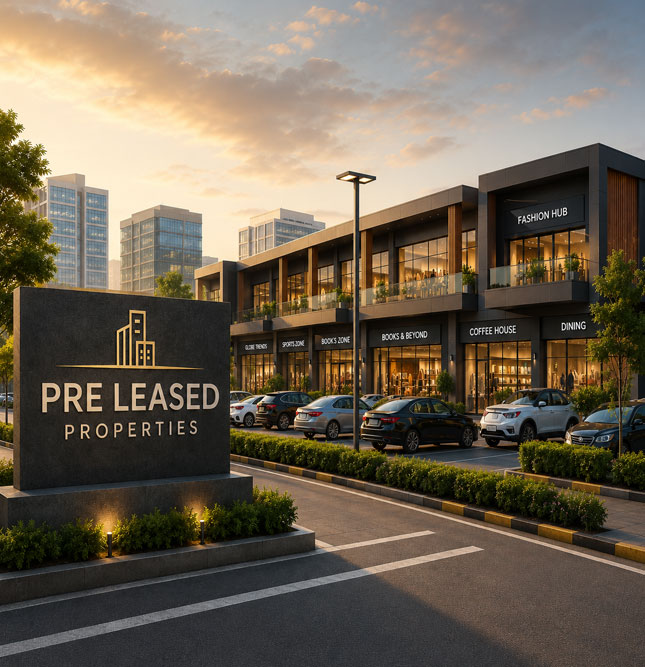
JAS Advisors helps investors locate and analyze pre-leased commercial property for sale in Mumbai. A pre-leased property is a commercial asset already occupied by a tenant under an active lease agreement. Offices, retail units, and selective commercial assets with existing tenants and active lease agreements are available. This structure allows an investor to acquire the property with an existing lease in place, subject to the lease terms and transaction arrangements, without the need to undertake a new tenant search. These investments are typically hybrid (debt + equity) investments providing diversification risk as well as good mid double-digit returns. JAS evaluates opportunities based on tenant profile, lease tenure, lock-in, rent, contractual rent increases, location, pricing, and other commercial considerations before an acquisition proceeds. Each opportunity remains subject to legal, financial, and property-level due diligence.
Request confidential pre-leased property opportunities in Mumbai.
JAS Advisors sources pre-leased commercial properties in Mumbai, Pune and Bangalore for investors seeking rental income under contractual rental arrangement along with an upside capital appreciation on exit of that investment. Most assets we evaluate are in range of ₹15 crore to ₹250 crore, with an active lease, an identifiable tenant, defined rental terms, and a documented lock-in period, where applicable. Tenants may include corporate occupiers, financial institutions, or other established businesses, subject to verification; returns and lease balance vary by deal.
Acquiring an occupied asset can reduce the leasing and tenant-search period associated with a vacant commercial property. An existing lease also provides defined rental terms for the buyer to review before acquisition, although the timing and continuity of rental income remain subject to the lease and tenant performance. This can be relevant to investors evaluating income-producing assets with guaranteed rental income and providing good capital upside.
| Investor question | Answer |
|---|---|
| When does income begin? | Immediately on investment since the licensee is already paying the rent |
| What creates the return? | Contractual rent, escalations, pricing, costs and exit value. |
Investors actively target pre-leased bank properties as well as properties leased to large MNC/global clients since these tenants provide unmatched lease stability and long-term operational commitment. However, the tenant's corporate reputation should be considered alongside a detailed review of the property and lease documentation. Comprehensive verification must cover the lease deed's precise legal entity, signatory authorization, lease tenure, lock-in periods, and termination clauses. Furthermore, buyers must evaluate escalation schedules, tax liabilities, fit-out reinstatement terms, and assignment rights.
Net Rental yield = Net NOI (annual contractual rent – payment obligations for owner) ÷ total acquisition cost × 100
A broader acquisition-cost calculation may include stamp duty, registration, brokerage, legal costs, applicable taxes and other transaction expenses. Financing costs should be assessed separately when evaluating leveraged returns.
Tell us your preferred Mumbai micro-market, budget and target yield.
Typically classified as Grade A tenants with proven track record and financial stability
We have a four-step acquisition process, which includes Understand, Shortlist, Verify and Close.
The Understand phase establishes the investor's target yield profiles, preferred geographic locations, asset classifications, and long-term liquidity objectives.
Shortlist requires high-performance institutional and off-market prospects against these standards.
The Verify stage does comprehensive legal underwriting, lease underwriting, and tenant due diligence.
Finally, the close phase establishes the detailed financial and transaction structures essential for the perfect implementation.
These investments are relevant to HNIs, family offices, and business owners seeking direct ownership of an income-generating real estate asset with an existing lease. Buyers who need immediate liquidity, expect fixed returns, or want low-ticket exposure may find direct ownership restrictive. REITs and fractional structures offer smaller ticket sizes and an easier exit; direct ownership offers control but ties up capital for longer.
Share your name, contact details, investment budget, preferred location, asset type, target yield, tenant preference, funding requirement, and purchase timeline, and JAS will match it against current inventory.
Opportunities, yields, tenants and availability are subject to verification and can change without notice.
Yes, but verify the tenant entity, executed lease, signing authority, and lock-in before relying on the bank's name alone.
Title documents, sanctioned plans, occupation evidence, the executed lease, rent receipts, and tenant KYC, reviewed independently by a lawyer.
Yield structures vary by property. Advertised figures are typically net yield after taking into consideration all relevant property expenses.
Outcomes depend on the lease's termination clauses and the tenant's financial position; a lock-in reduces exposure but does not remove it.
Yes, lease-rental discounting (LRD) and commercial loans are available, subject to strict underwriting, tenant credit profiles, and lender compliance policies.
Not universally. Pre-leased assets bring earlier income; vacant ones offer more flexibility to reposition.
JAS starts with your requirement, identifies matching assets, and coordinates document checks before negotiation, without claiming exclusive access to every listing.
Yes, NRIs and family offices can invest, subject to specific FEMA regulations, capital repatriation frameworks, and institutional tax structures.